Thinking Better Together: Information
In this series of blog posts, I will be exploring the 10 Components of a Thinking Environment® and bringing each component to life by sharing my own personal experiences and stories of how these components make a positive difference in the world.
All quoted text is attributed to Nancy Kline, unless otherwise indicated.
This post explores the component of Information.
Information is about “Absorbing all the relevant facts” knowing that “withholding or denying information results in intellectual vandalism” and that “facing what you have been denying leads to better thinking.”
In the chapter dedicated to the component of Information in The Promise That Changes Everything Nancy offers up these questions: “What uncomfortable actualities can we uncover today that fill in the picture more accurately? What new land can we traverse to arrive where the veracity lies? How brazenly can we seek a wider truth when it disquiets our narrow own?” Elsewhere, Nancy has said that “brave thinking dismantles denial”.
So, we might think about Information as the thing that makes it possible to move past the safety, false certainty and convenience of denial to open to a bigger truth.
Confirmation Bias is a well-understood feature of the human brain. Our beliefs want to be proven true, so our brains have an unfortunate tendency to filter out information that challenges our current thinking. That’s why it is important to explicitly state Information as an essential component of a Thinking Environment® – to intentionally over-ride Confirmation Bias and encourage us to gather more information – even if doing so threatens our current ways of thinking, perhaps even our world view.
Of course, this takes tremendous courage.
When we have attached the core of our identity to a certain perspective or worldview, being open to information that threatens this is a huge deal. It is so much more convenient to carefully curate a limited data-set that leaves our current thoughts and beliefs neatly intact.
The problem is that this does not help us if we truly want to think afresh, for ourselves.
To think afresh for ourselves we must work hard to seek out divergent perspectives. To look for the things we don’t want to see and listen for the things we don’t want to hear – and then we must and fight the urge to turn away and find the courage to turn towards this new Information.
Of all the components, perhaps staying truly open to new Information is one of the most challenging.
One of the tools that perhaps can help to guide us as we move into the unknown in the Johari Window.
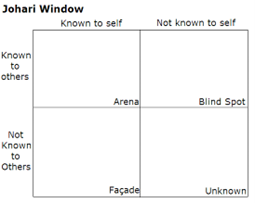
Johari Window
The author Charles Handy referred to this model as the “Johari House with four rooms.” He explains “Room one (the Arena) is the part of ourselves that both we and others can see into. Room two (Blind Spots) contains aspects that others see but we are unaware of. Room three (Unknown) is the unconscious part of us that neither we ourselves nor others see. Room four (Façade) is the private space we know but hide from others.”
The components of The Thinking Environment® empower us to move beyond the boundaries of that first familiar and comfortable room “The Arena” and encourage us explore the unknown.